
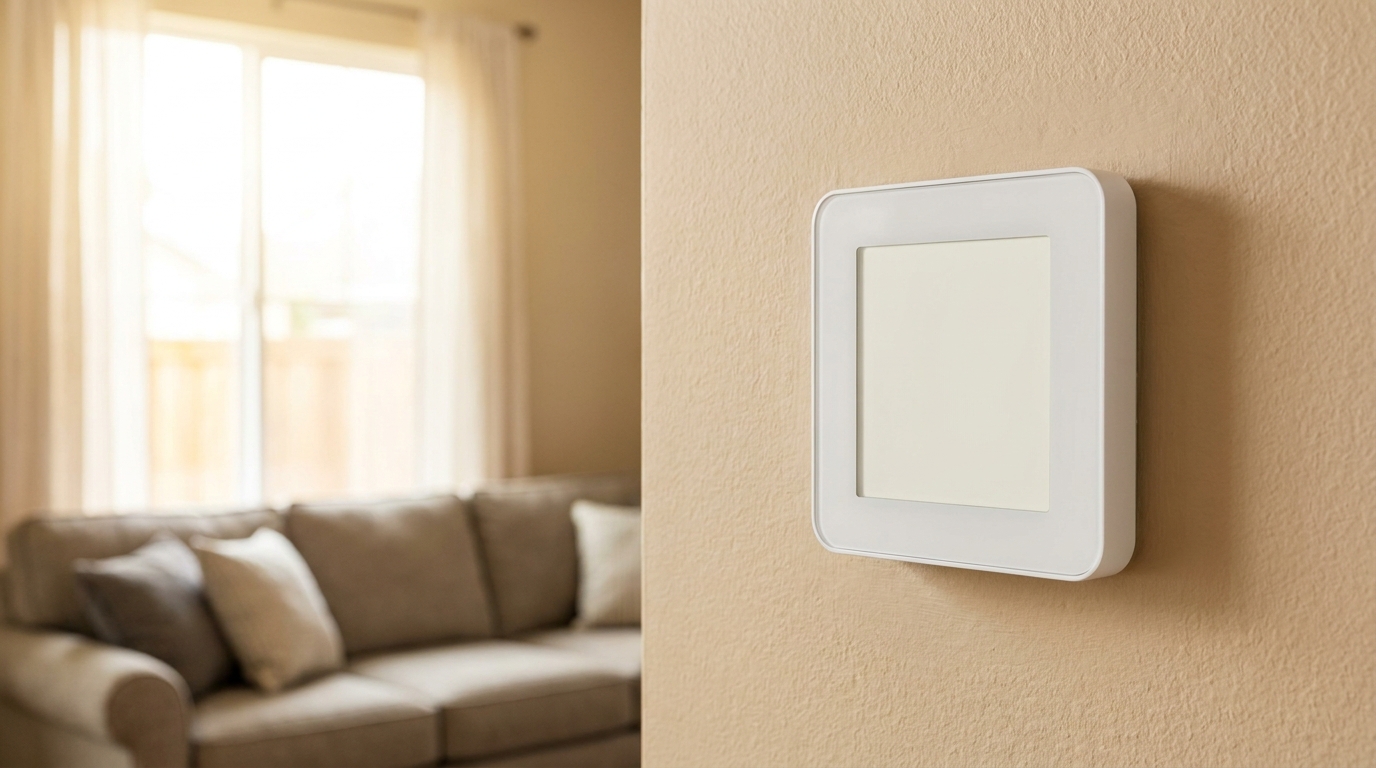
Somewhere in your house there is a small plastic rectangle that two people disagree about. It has been the subject of more household negotiation than the grocery budget. And every few months somebody looks it up, finds an article that says "set it to 78 in summer and 68 in winter," announces this to the family as settled science, and gets overruled by dinnertime.
So let's talk about the recommended thermostat settings for summer and winter in a way that survives contact with an actual Alabama house. The government numbers are a starting point, not a verdict. What matters more is how you use the setting — steady versus swinging, day versus night, home versus gone — and whether the humidity in your house is quietly making a perfectly reasonable temperature feel wrong.
The short answer, then the honest answer
The standard guidance, and it's not bad: 78°F when you're home in summer, 68°F when you're home and awake in winter. Those are the numbers the Department of Energy publishes, and they're built around a real relationship — every degree you move the setting toward the outdoor temperature saves energy, roughly 1–3% off heating or cooling costs per degree.
Here's the honest part. In central Alabama in August, 78°F with our humidity can feel like sitting in a warm dishtowel, and a recommendation nobody follows saves exactly zero dollars. The more useful framing is this: find the warmest summer setting and the coolest winter setting you're genuinely comfortable at, then hold it there. Consistency beats optimization. A house held steady at 74 all season costs less to run than one that gets yanked between 68 and 78 depending on who walked past the wall last.
A realistic schedule for both seasons
This is the table we'd actually hand a neighbor. Treat the ranges as a starting point and adjust one degree at a time.
| When | Summer | Winter |
|---|---|---|
| Home and awake | 74–78°F | 68–70°F |
| Sleeping | 72–75°F | 65–68°F |
| Away for the workday | 80–82°F | 62–65°F |
| Away several days | 83–85°F (never off) | 60–62°F (never off) |
A few notes on why these numbers look the way they do.
The sleeping numbers are lower in summer for a reason that isn't about your bill. Body temperature drops as you fall asleep, and a cooler room helps that along — most sleep research lands somewhere in the mid-60s to low-70s as the comfortable range. If you sleep badly in July, the best AC temperature for sleeping is probably two or three degrees below whatever you run during the day. That's a legitimate use of your system, not a waste.
The away numbers are where the actual savings live. Setting back 7–10 degrees for the eight hours you're at work is worth more than almost anything else you can do with a thermostat. There's an old myth that letting the house drift and then recovering costs more than just holding steady — it doesn't. A house loses heat (or gains it) faster the bigger the gap with outside, so a house allowed to drift toward outdoor temperature is losing energy more slowly the whole time you're gone.
Heat pump owners, one exception: if you heat with a heat pump, don't do deep winter setbacks. Asking it to climb 8 degrees when you get home usually kicks on the electric auxiliary heat strips, which are expensive, and you'll spend more recovering than you saved drifting. Two or three degrees is plenty. If your system is a heat pump and you're not sure what's normal in cold weather, our post on whether a heat pump "blowing cold air" is a problem covers what defrost cycles look like.
Why 78 feels wrong in Alabama (and it's not you)
Comfort isn't temperature. It's temperature plus humidity, and down here the second half of that sentence does most of the damage.
At 50% indoor relative humidity, 76°F feels pleasant. At 65% humidity, that same 76 feels sticky and close, and your instinct is to chase the feeling by dropping the thermostat — to 74, then 72, then you're running the system nonstop and still not comfortable. You're treating a moisture problem with a temperature lever. It sort of works, and it's expensive.
A healthy AC dehumidifies as a side effect of cooling, and a well-matched system in a well-sealed house should hold you somewhere around 45–55%. If yours can't — if the house is cool and clammy at the same time — something's off. Common culprits: an oversized system that satisfies the thermostat in short bursts and never runs long enough to wring moisture out, a dirty coil, or low refrigerant. We wrote up what indoor humidity should actually be in an Alabama home if you want to go deeper on that.
The practical version: if you can get your humidity down, you can raise your thermostat a couple of degrees and feel better than you did at the lower setting. That's the whole trick, and it's the one nobody puts in the "set it to 78" articles.
The habits that undo a good setting
- Cranking it way down to cool off faster. Your AC only has one speed. Setting it to 65 doesn't chill the house quicker — it just runs long past the point you actually wanted, and half the time somebody forgets to set it back.
- Fighting over it all day. Every adjustment is a new call for heating or cooling. Pick a number, agree on it, leave it.
- Leaving ceiling fans running in empty rooms. A fan cools people, not air. In an occupied room a fan lets you sit comfortably 3–4 degrees warmer, which is real money. In an empty room it's just a small heater with good PR.
- Turning the system fully off while you travel. In an Alabama July that's how you come home to a swamp — high humidity, musty smells, and occasionally mold. Set it up to 83–85, don't switch it off.
- Trusting a thermostat that's lying. A unit reading three degrees off, or one mounted in direct afternoon sun or above a lamp, will run your system to a number that isn't the number in your house.
Is a smart thermostat worth it?
For most households, yes — but not for the reason it's usually sold.
The value isn't the app. It's that the setback discipline happens whether or not anyone remembers. The single biggest savings lever above is "set it back while you're gone," and that's precisely the thing humans are worst at doing consistently for six months straight. A programmable or smart thermostat just does it. Most people recoup the cost within a couple of cooling seasons, and if your schedule is unpredictable, geofencing handles the part a fixed schedule can't.
One caveat worth saying out loud: a smart thermostat on a struggling system is a nicer window onto a problem, not a fix for it. If the house won't hold the number you set, the thermostat isn't the thing that needs replacing.
When the setting isn't the problem: if your house used to hold 74 and now can't, or the system runs and runs without reaching the setpoint, or some rooms are five degrees off from others — that's not a thermostat conversation. That's a system telling you something. Low refrigerant, a dirty condenser coil, a failing capacitor, and leaky ductwork all show up exactly this way. A maintenance visit will sort out which.
The bottom line
Recommended thermostat settings for summer and winter come down to three things: pick a number you can actually live with, hold it steady instead of chasing it, and set it back hard while you're gone. Do those and you've captured most of the available savings without owning a single new gadget. And if the number you can live with keeps drifting lower every summer, pay attention to that — it usually means the humidity or the equipment is the real story, not the setting.
House won't hold the temperature you set it to in Birmingham, Trussville, Vestavia Hills, or Hoover? Schedule a visit with Ethridge HVAC or call (205) 509-4545. We'll check the charge, the airflow, and the thermostat calibration, and tell you straight whether you've got a settings problem or a system problem.